
Futarchy
How Meta-DAO Challenges Governance as We Know It

Executive Summary
This document provides an in-depth exploration of the Meta-DAO and its innovative governance model based on the concept of futarchy. Futarchy, a blend of futures markets and traditional decision-making processes, shifts conventional governance from simple voting to market-driven predictions. Initiated by economist Robin Hanson and popularized within the blockchain community by Vitalik Buterin, futarchy has been adopted by Meta-DAO as a novel approach to decentralized governance.
Futarchy in Meta-DAO utilizes speculative markets where participants buy and sell tokens representing their forecasts on various proposals' impacts on the organization's value. This model aims to utilize collective intelligence, ensuring decisions align with the broader interests of the DAO and its native token, META.
The document outlines the basics of futarchy, its implementation in Meta-DAO, and contrasts it with traditional governance models, highlighting its potential for more efficient and aligned decision-making. Through hypothetical scenarios and real-world challenges, the document shows the practical applications and implications of futarchy within the blockchain ecosystem.
Key sections include an introduction to futarchy, background information on traditional and market-driven governance, detailed insights into the operational mechanics of futarchy in Meta-DAO, and the advantages and challenges of adopting such a model. The document concludes with a call to action for stakeholders to engage with and contribute to the futarchy-driven governance landscape, emphasizing the importance of collective participation and innovation in shaping the future of decentralized organizations.
This executive summary serves as a gateway to understanding the transformative potential of futarchy within Meta-DAO and the broader context of decentralized governance, inviting readers to delve deeper into the mechanics, benefits, and challenges of this pioneering approach.
1. Introduction
The advent of blockchain technology has encouraged innovative approaches to governance, leading to the creation of decentralized autonomous organizations (DAOs). One such innovative approach is Meta-DAO, a new type of organization that differs from traditional hierarchical structures and decision-making processes. Instead, it uses a bold new approach called futarchy, where decisions are made based on predictions and market mechanisms instead of traditional voting.
Futarchy, a concept introduced by economist Robin Hanson, hypothesizes that speculative markets are superior to conventional democratic or managerial decision-making systems. In other words, futarchy is letting people bet on the best way to solve problems instead of just voting, and then picking the solution that most people believe will work the best. The core idea is to vote on values, but bet on beliefs. Hanson originally developed the idea of futarchy based solely on economic theories and political concepts, without any connection to blockchain technology.
In the context of Meta-DAO, futarchy is implemented by creating markets for each decision to be made. Here, participants can buy and sell tokens based on their predictions of the outcome's impact on the organization's overall value, represented by the price of its native token, META. This approach believes that participants in the market, motivated by their own financial gains, will make smart and logical choices that, when combined, are in the best interest of the organization.
The purpose of this document is to provide a comprehensive overview of Meta-DAO and its unique governance model. We aim to clarify the principles of futarchy, demonstrate its application within Meta-DAO, and explore the implications of this novel approach to decentralized governance. Our goal is to inform and guide potential participants, stakeholders, and observers in understanding the significance, mechanics, and potential of Meta-DAO as a pioneering example of futarchy in action.
2. Background Information
What is Futarchy?
Futarchy is a way of making decisions, ideated by the economist Robin Hanson in early 2000. Imagine if, instead of just voting for what should happen, people could bet on the future they think is best. The idea is that if you let people bet on different outcomes, the choices with the best bets (where people put their money where their mouth is) should happen. It's like combining betting with voting to make decisions. Although it was first conceived for countries, Robin Hanson suggested first implementing it on a smaller scale, such as in small villages or corporations. Initially, Vitalik Buterin introduced and popularized the concept of futarchy within the blockchain community in 2014. He proposed that Futarchy could serve as an effective governance model for DAOs on the Ethereum blockchain. To our knowledge, Meta-DAO is the first organization in the world to employ a futarchy system of governance.
Traditional Ways of Making Decisions and Problems With Them
Usually, companies and countries make decisions in a couple of common ways. In companies, bosses and managers decide what happens next — we call this a top-down approach. In countries, people vote, and the majority decision wins. But these ways can have problems. Sometimes, in companies, the bosses might not know what's best for everyone, or they might make decisions that are good for them but bad for others. In voting, sometimes the majority isn't always right, or they might pick something good for them but bad for others. Both ways can be slow and might not always get the best results.
What is Market-Driven Governance?
Market-driven governance means using markets (like how we buy and sell things) to make decisions instead of just having a boss decide or everyone voting. In markets, prices help tell us what people really want or think is valuable. In market-driven governance, decisions are made based on what these prices tell us. This could mean looking at how the price of an organization's token changes to decide what the company should do next. The idea is that this could make decisions faster, more about what's good for everyone, and match better with what people actually want and need.
3. Understanding Futarchy
Futarchy turns decision-making into a market where the future decides what we should do. Instead of everyone just voting yes or no, people put their money on the line to bet on what they think the best choice is.
Here's how it all breaks down:
Decision Markets: Their Role and Definition
Think of decision markets as places where you can bet on what the future will look like if we make certain decisions. Each choice we could make has its own "shop" or market. People can bet money on whether they think the decision will be good or bad for Meta-DAO. If a lot of people think a decision will make the DAO more valuable, the price in that market goes up. If they think it'll be bad, the price goes down.
Betting Markets and Prediction Markets: How They Work
These markets work by letting people bet on the outcomes they believe in. If you think a new project will boost Meta-DAO's value, you'd buy shares in the 'yes' market for that decision. But if you think it's a bad idea, you'd buy shares in the 'no' market. Over time, the prices in these markets show what all the bettors collectively think will happen. It's a way to see into the future, based on what people are willing to bet their own money on.
Role of Tokens or Cryptocurrency in Futarchy
In Meta-DAO, the native token, META, is at the heart of futarchy. When people make bets in the decision markets, they use META tokens. This means the value of META reflects what people think of the DAO's future based on its decisions. If the DAO makes good decisions, the value of META should go up, because the decisions should make the DAO more successful. This ties everyone's fortunes to the success of the DAO: if you help make good decisions, you profit.
Comparison with Traditional and Other Alternative Governance Models
In traditional models, like companies or countries, decisions are made by bosses or votes. But these can be slow and don't always lead to the best outcomes. In futarchy, instead of just going with what one person says or what most people vote for, decisions are made based on what actions will actually increase the value of the DAO, as shown by real bets in the market. It's a whole new way of making choices, based on what people think will work, not just what they say they want.
This new approach is exciting because it could lead to smarter decisions, faster actions, and better outcomes for everyone involved. By betting on futures, everyone in Meta-DAO has a say in its direction, but instead of just a vote, their say is backed by their own money and beliefs in what will truly benefit the DAO.
Example of Using Futarchy in Action: Anatoly Yakovenko and Solana Labs
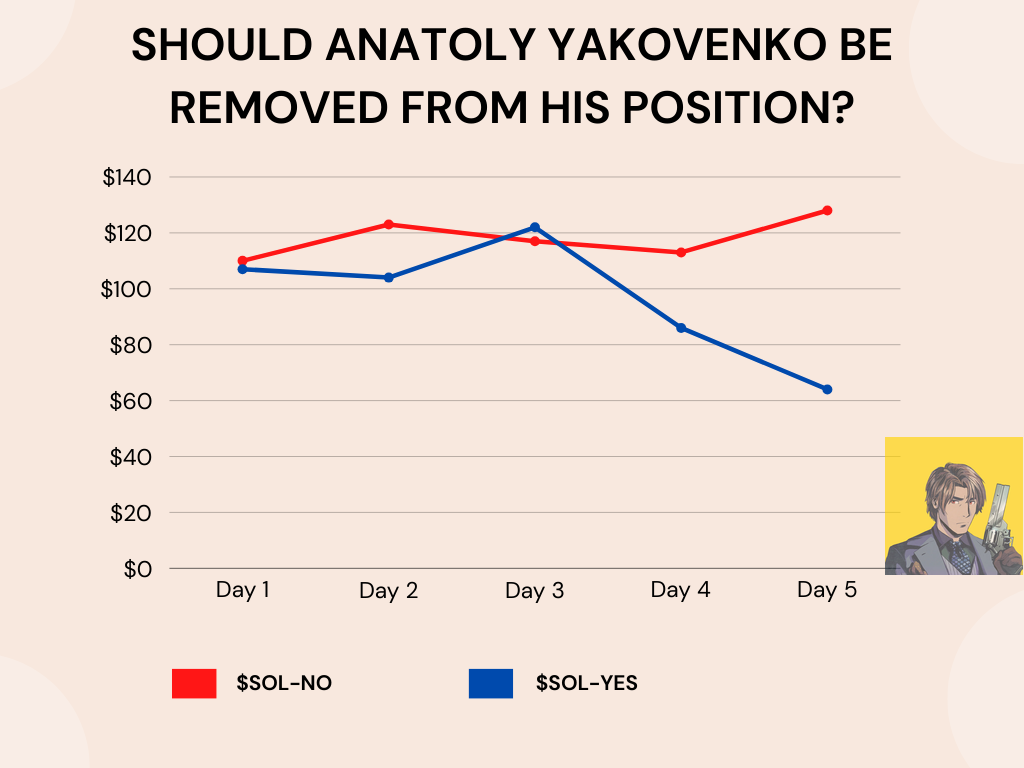
Let's explore a hypothetical scenario where the Solana community faces a controversial decision: whether Anatoly Yakovenko, the CEO of Solana Labs, should be removed from his position.
The Solana community is concerned about recent network outages and debates whether leadership changes, including the potential firing of CEO Anatoly Yakovenko, could improve the network's reliability and public perception.
Implementing Futarchy
Establishing Decision Markets:
Two decision markets are set up: one for removing Anatoly Yakovenko (Yes Market) and one for keeping him as CEO (No Market). These markets allow participants to buy and sell tokens based on their predictions of Solana's value following either decision.
Community Engagement:
The Solana Labs team informs the community about the decision markets, encouraging stakeholders, including developers, investors, and users, to participate. The community is reminded that their engagement will directly influence this crucial decision.
The Futarchy Experiment
Betting Phase:
Community members start placing their bets. If they believe the Solana network will perform better and increase in value without Anatoly, they invest in the Yes Market. Conversely, if they believe Anatoly's leadership is vital for Solana’s success, they buy tokens in the No Market.
The prices of the Yes and No market tokens begin to fluctuate, reflecting real-time sentiment and predictions from the community.
Data Analysis:
As the betting period progresses, the Solana Labs team and the broader community monitor the market dynamics. Suppose the value of the No Market tokens (supporting Anatoly's continuation as CEO) consistently outperforms the Yes Market. This indicates a stronger community confidence in his leadership.
Executing the Decision:
Following the closure of the betting period, the market with the higher ending token value dictates the decision. In this case, if the No Market prevails, it signifies community support for Anatoly to remain as CEO.
The decision is implemented accordingly. Anatoly stays, reinforced by the community’s backing, reflected through their market participation.
Outcome and Evaluation:
With Anatoly continuing as CEO, the community watches closely for changes in the network's performance and public perception. If improvements are observed and Solana's value increases, it validates the futarchy-driven decision.
The Solana community reviews the effectiveness of futarchy in this high-stakes decision. Regardless of personal opinions, stakeholders had a direct hand in shaping the outcome through a market-driven process, enhancing transparency and collective responsibility in governance.
Conclusion
In this hypothetical scenario, the Solana community leveraged futarchy to tackle the sensitive issue of leadership. By making bets in specialized markets, stakeholders could express their beliefs not just as opinions but as financial stakes tied to the future success of Solana. This example illustrates how futarchy can be applied to make significant governance decisions, turning collective predictions and values into actionable outcomes.
4. Participating in a Futarchy
How to Get Started with Futarchy in a Meta-DAO
Learn the Basics: Start by learning what futarchy is and how it changes the way decisions are made. Look up information online or read articles to get a good grasp.
Join the Community: Jump into the Discord channel! It's where everyone talks, shares ideas, and works together.
Dive into Proposals: Watch what’s going on with current proposals, or even join in. It’s a great way to see how things work.
Share Your Skills: Can you write, design, or analyze data? Your talents can help the community in many ways.
Start Trading: Try your hand at trading in our unique markets to get a feel for how the system works.
Keep Learning: Stay up-to-date with what's happening in Meta-DAO and the wider world of futarchy.
Points of contact
Dean & Nico - Community
Blockchainfixesthis - Content Production
Proph3t - Core Smart Contracts / General
0xNallok - Business Development / General
Dodecahedr0x - Core Codebase (UI & Smart Contracts)
Understanding Conditional Markets
Begin by acquiring USDC or META. Go to the Meta-DAO website, pick a decision topic you care about, and use your cryptocurrency to get special tokens for voting. The trading mechanics mirror those of traditional markets, but here, your trades reflect your predictions on Meta-DAO’s proposals.
Trading in conditional markets mirrors the standard operations seen in traditional financial markets, including the use of market orders, limit orders, and the typical bid-ask processes.
Upon launching a proposal, two distinct conditional markets are created: one reflecting the scenario where the proposal succeeds (pass market) and another envisioning the outcome if it fails (fail market). These markets run parallel over a designated period, often five days, allowing participants to trade based on their predictions.
Pass Market: This reflects your belief that Meta-DAO will benefit if the proposal is approved.
Fail Market: This reflects your belief that no changes are necessary.
Over time, the difference in META's price in these markets shows what people think will happen. The market with better support from the community at the end of the trading period decides the final outcome.
While the trading happens, an oracle tracks the Time Weighted Average Price (TWAP) of META within both markets. Post-trading period, the market boasting a higher TWAP dictates the proposal's outcome, marking whether the community want its implementation (pass) or rejection (fail).
Outcome Determination: At the trading period's end, one market (either pass or fail) is considered the winner based on which has the higher value. The tokens from the winning market (pUSDC or pMETA if the pass market wins) become actual USDC or META. Conversely, tokens from the losing market become valueless and are effectively removed or "burned".
Token Minting and Settlement: When you first deposit your cryptocurrencies, you get two kinds of tokens - one for yes and one for no. The real value comes only when one of these choices wins.
Market Dynamics: All trading actions are genuine, involving real exchanges of tokens. Yet, only the transactions in the winning market have lasting impacts, turning what might have been speculative bets into real tokens.
How to Value Meta-DAO?
Valuing Meta-DAO involves a blend of strategies and forecasts, some of which are based on speculative financial models. These models often outline potential revenue streams, but it's worth noting that not all proposals will come equipped with such detailed projections. Despite this, each proposal can still influence META's value differently, whether in the immediate future or down the line.
Long-Term vs. Short-Term Impacts: Some initiatives might have a profound long-term effect, like launching a business that taps into broader markets. Others might have more immediate, short-term financial implications, such as releasing funds from the treasury for specific services. We encourage the community to dive deep into these models, discuss their potential impacts, and even bring personal valuation methods to the table. The more diverse the perspectives, the richer the market's understanding.
Valuation Techniques:
Comparable Analysis: Look at similar projects within the DeFi space or startup ecosystems. How are they valued? This can give a ballpark figure for Meta-DAO's potential market capitalization or value.
More about comparable analysis hereVenture Capital (VC) Method: This approach involves estimating the future exit value of Meta-DAO and working backward to determine its current worth, calculating in your desired return on investment.
More about Venture Capital (VC) Method hereBerkus Method: This method assigns monetary value to non-tangible assets like the strength of the team, the viability of the idea, or strategic partnerships Meta-DAO may have.
More about Berkus Method here
Each of these methods offers a different lens through which to assess Meta-DAO's value, contributing to a more nuanced and comprehensive market understanding.
5. Advantages of Futarchy
Addresses Traditional Governance Limitations
Futarchy tackles common issues in traditional governance models such as lack of accountability, low participation, and decision-making bias. By leveraging market mechanisms, futarchy can potentially increase transparency and ensure that decisions reflect the informed consensus rather than the preferences of a few.
Benefits for Participants and Community
In a futarchy-driven system, all participants have a stake in the outcome, aligning individual incentives with the community's welfare. This can lead to higher engagement levels, more informed community members, and decisions that better reflect the collective will and knowledge.
Evidence of Effectiveness
Although futarchy is a relatively new concept and real-world examples are limited, its principles have shown promise in decentralized organizations and theoretical models. It capitalizes on the idea that markets are efficient information aggregators, potentially leading to more informed and effective decision-making.
6. Examples of Challenges and Criticisms
In this section, we explore various challenges and criticisms associated with futarchy through illustrative examples, focusing on instances of market manipulation, information asymmetry, and misinformation spread.
Each case highlights the intricate dynamics between community actions and market responses, underlining the importance of collective decision-making, transparency, and informed participation in addressing these challenges within the framework of futarchy governance.
Additionally, it's important to note that these challenges and criticisms could potentially impact any governance model. What sets futarchy apart is our clear understanding of participant agendas, potential manipulations, and where incentives lie.
Example of Challenges and Criticisms in Action: Market Manipulation with Vitalik Buterin
Let’s take the previous example. The Solana community is faced with the decision of whether CEO Anatoly Yakovenko should be removed from his role.
Market Manipulation Incident:
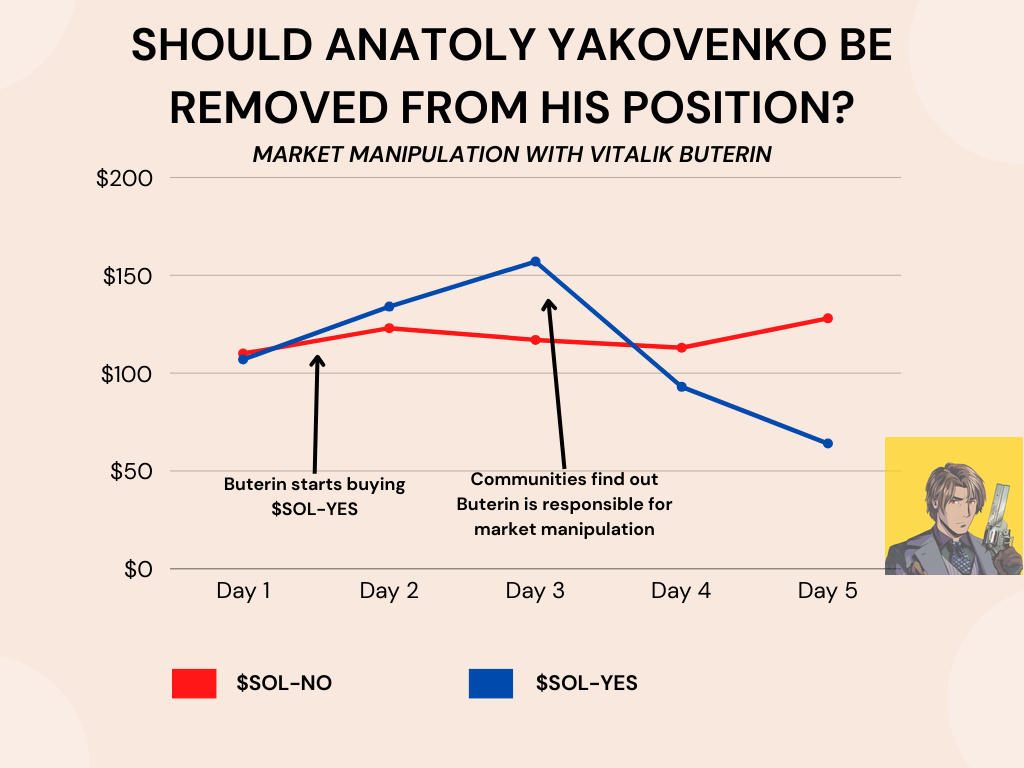
Ethereum Co-Founder Vitalik Buterin, potentially seeking to undermine Solana, buys a substantial amount of $SOL-YES tokens, indicating a vote for Yakovenko's removal. This unexpected move skews the market dynamics significantly.
Community Response:
The Solana community, observing Buterin's market manipulation, starts to counteract by purchasing $SOL-NO tokens in support of Yakovenko, aiming to correct the market's direction and protect their ecosystem. In addition, the Ethereum and other blockchain communities, offended by Buterin’s action, decide to support the Solana ecosystem, buying more $SOL-NO tokens.
Data Analysis and Outcome:
As the betting phase progresses, communities watch the market trends closely. Despite Buterin's initial heavy influence, the $SOL-NO market remains strong, reflecting solid community backing for Yakovenko. The broader market is aware that this is only an attempt to undermine the ecosystem. This resilient response signals the community's preference and counters the manipulation attempt.
Evaluation and Conclusion:
This scenario highlights a key challenge in futarchy: market manipulation. However, it also illustrates the potential for community action to correct skewed markets. The strong support for $SOL-NO, despite manipulation, reinforces the importance of community consensus and the robustness of futarchy mechanisms against external disruptions.
Example of Challenges and Criticisms in Action: Information Asymmetry in Futarchy
Imagine a situation within Meta-DAO community, where they must decide on adopting a new technology framework. The decision is crucial for the future of the project.
Information Asymmetry Incident:
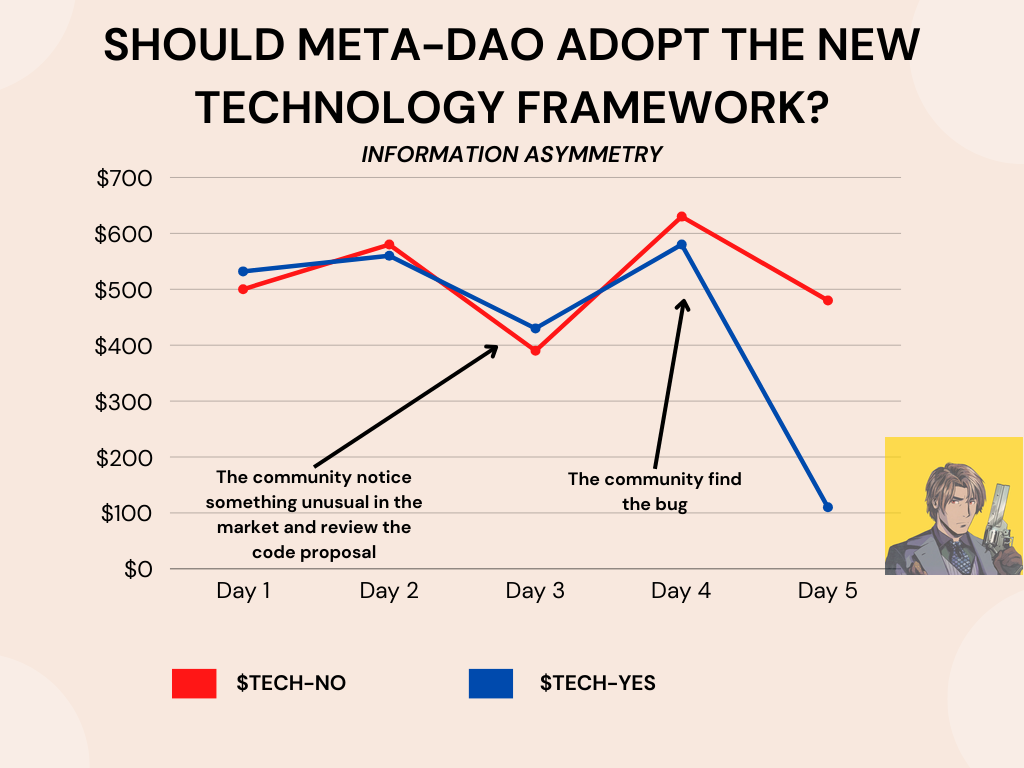
A small group of highly informed insiders, noticed a bug in the smart contract and start buying $TECH-NO tokens, but do not share their insights with the broader community. The lack of shared knowledge creates an information asymmetry. This act misleads the broader community, causing confusion and misguided investments in $TECH-YES tokens due to the perceived undervaluation.
Community Response:
As the broader Meta-DAO community starts noticing unusual market activity, they face a dilemma due to a lack of information. Some members start buying $TECH-YES tokens, fearing manipulation or undervaluation without understanding the insiders' knowledge. However, since the technology is open-source, other community members begin to review and comprehend the potential bug. External experts and other DAOs contribute to the discourse, enhancing transparency and understanding.
As knowledge spreads, more members start purchasing $TECH-NO tokens, aligning market sentiment with informed consensus. The proposal must not be implemented.
Evaluation and Conclusion:
In this example, Meta-DAO faced a challenge due to hidden information. However, the community's collective effort and the open-source nature of the technology allowed for transparency and eventually led to a well-informed decision. This shows how futarchy can overcome obstacles like information gaps and ensure decisions reflect the community's true interests.
Example of Challenges and Criticisms in Action: Spread of Misinformation in Futarchy
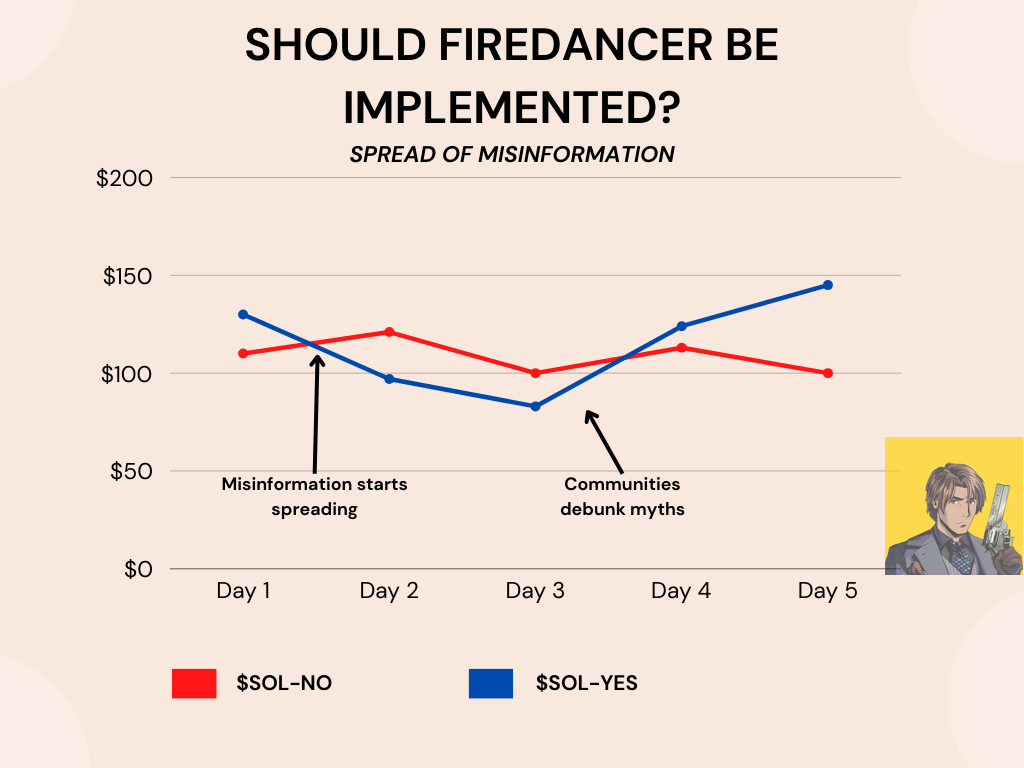
Solana is considering integrating Firedancer, a new validator client to increase its networking throughput, resilience, and efficiency. This is a significant decision with wide-ranging implications.
Misinformation Incident:
Rumors start circulating within the community, suggesting exaggerated benefits of the new feature. Some say Charles Hoskinson, the founder of Cardano, contributed to developing the new validator. Others claim that former FTX CEO Sam Bankman-Fried commissioned the new validator for money laundering purposes. These rumors influence market trends, leading to a skewed $FIRE-NO token purchase.
Community Response:
The community notices irregularities and discussions begin to debunk myths. Informed members and external analysts contribute facts, clarifying misunderstandings. This collective effort helps balance the market, leading to more purchases of $FIRE-YES tokens.
Evaluation and Conclusion:
This scenario underlines how futarchy addresses misinformation thanks to its strength in community-driven clarification and decision-making. It highlights the importance of informed participation and critical analysis in futarchy environments.
Side Note Criticism: Whales
In this side note, we tackle the issue of big players, also known as 'whales,' who have enough power to change or twist the result of a vote. This could happen for selfish reasons. For example, imagine if a well-known person like Frank DeGods could get 1M META to switch back to Solana. Clearly, Frank DeGods would want to make the vote go his way to get that 1M META. But, it's not always about personal gain. Sometimes, someone might push for something because they truly believe it's the right thing to do, like a validator wanting higher fees on Solana.
It's important to remember that no governance system is perfect. They all have their pros and cons. 'Whales', often referred to as major donors in democratic systems, play a significant role due to their substantial contributions and influence. Their financial clout can shape policy decisions and sway public opinion. What makes futarchy different, especially with blockchain, is that it includes a kind of emergency stop. In scenarios dominated by the influence of 'whales,' the broader community emerges as this 'kill switch,' retaining the capacity to initiate a fork of the existing projects.
This process empowers the community to dictate the trajectory the DAO should follow. The historical precedence set during the Bitcoin Fork battle serves as an example to this approach, underscoring that over time, the path forged by the majority consensus — rather than by pure financial power — prevails.
7. Futarchy in Action: Case Studies
The Story of Proposal 3
"The Story of Proposal 3" outlines Meta-DAO's initial setup with a $10,000 treasury and 65 members. By February 2024, following strategic partnerships and grants, their funds increased to $30,000.
A proposal to raise $75,000, partly to enhance META/USDC liquidity, was passed despite objections over value discrepancies. Direct market actions, spreading misinformation, and negotiation were considered but ultimately seen as impractical or harmful. The proposal's success reflects the intricate dynamics of DAO governance and market-driven decisions, highlighting the challenges in influencing decentralized systems
Information Successes of Speculative Markets
The case study (Pages 5-7) analyzes markets where people bet on future events, like stock markets or betting on horse races, are good at using lots of people's knowledge to predict outcomes. These markets can often guess outcomes better than experts or polls. This suggests they might help make decisions better than traditional ways like voting.
8. Conclusion
Meta-DAO's adoption of futarchy represents a significant shift from traditional governance models towards a more decentralized, market-driven approach. By leveraging speculative markets, Meta-DAO aims to harness collective intelligence and financial incentives to make more informed and effective decisions.
The principles of futarchy, as explored in this document, underscore the potential for speculative markets to outperform traditional voting and decision-making systems. This innovative approach allows participants to not only vote with their values but also to bet on their beliefs, aligning individual gains with the collective success of the organization.
The case studies and scenarios outlined above demonstrate both the potential advantages and the challenges associated with implementing futarchy. From addressing traditional governance limitations to navigating issues of market manipulation and information asymmetry, the journey of Meta-DAO offers valuable insights into the complexities of market-driven governance.
As we look to the future, the role of futarchy within Meta-DAO and beyond remains a promising avenue for exploration and experimentation. We invite all stakeholders, from casual observers to active participants, to engage with this novel governance model. By contributing ideas, participating in proposals, and trading in conditional markets, each member of the community can play a part in shaping the evolving landscape of decentralized governance.
Let this document serve as a call to action for all interested parties to dive deeper into the world of futarchy, to experiment, to debate, and to contribute to the collective understanding and refinement of this pioneering governance model. The journey of Meta-DAO is not just about testing a new system; it's about reimagining the very foundations of organizational decision-making for the betterment of all.
9. References and Further Reading
The Father of Futarchy Has an Idea to Reshape DAO Governance - CoinDesk
DAOs, DACs, DAs and More: An Incomplete Terminology Guide - Vitalik Buterin
'The Goal Is Number Go Up': Inside a DAO’s Radical Governance Experiment - CoinDesk
Curtis Yarvin vs Robin Hanson - Debate Monarchy vs Futarchy 2010
Curtis Yarvin challenged by Milton Friedman's son Professor David Friedman
EB98 – Robin Hanson: Futarchy, Prediction Markets And The Challenge Of Disruptive Technology